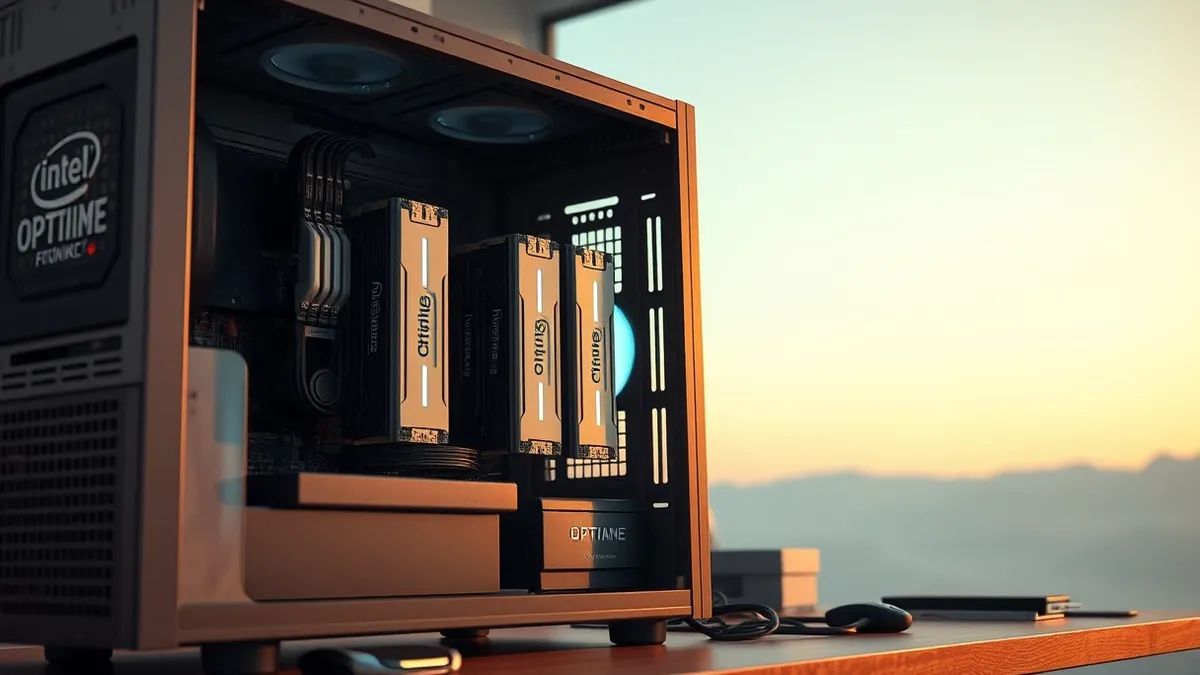
A Reddit homelab builder successfully ran Moonshot AI’s 2.8-trillion-parameter Kimi K3 model using only a CPU and discontinued second-generation Optane persistent memory, according to the published report This demonstration highlights an alternative path for high-capacity memory access when traditional DRAM becomes prohibitively expensive for individual users.reported
Evidence: reported
Homelabber uses second-gen Optane memory sticks to run a 2.8-trillion-parameter AI model on CPU aloneaifleet-tomshardware
What was released or claimed
The builder utilized Intel’s Optane Persistent Memory 200 Series, which launched in 2020 for third-generation Xeon Scalable processors. according to the published report, the setup employs a 40-core CPU and avoids GPU acceleration entirely.reported The system operates in App Direct Mode, allowing software to map the Optane memory directly rather than using it as a cache for DRAM. This configuration provides more control over where model tensors reside, though it requires active cooling with dual 12-watt blower fans to manage heat.reported
Evidence: reported
Homelabber uses second-gen Optane memory sticks to run a 2.8-trillion-parameter AI model on CPU aloneaifleet-tomshardware
Evidence: reported
Homelabber uses second-gen Optane memory sticks to run a 2.8-trillion-parameter AI model on CPU aloneaifleet-tomshardware
Who it affects
This development primarily impacts hobbyists and homelab builders seeking to run large AI models without expensive enterprise hardware. It also interests users facing high DRAM prices, as the builder noted that secondhand Optane costs a fraction of equivalent DRAM capacity. The community of users interested in CPU-only inference for massive models may find this approach viable for specific, non-real-time workloads.
What is still unknown
It remains unclear how broadly this specific configuration can be replicated with other large models or if performance scales linearly with different quantization levels. The long-term reliability of running these discontinued memory modules at high thermal loads is not documented in the report. Additionally, the total cost of ownership, including electricity for cooling, is not detailed.
What to make of it
The experiment demonstrates that massive memory capacity can be achieved through legacy enterprise hardware, bypassing current DRAM market constraints. However, the trade-off is significant performance degradation compared to GPU-accelerated or DRAM-heavy setups. The builder’s advice to treat active DIMM cooling as mandatory underscores the thermal challenges of this approach.
What buyers should weigh
Buyers considering similar setups must account for the severe speed limitations, with inference at 0.85 tokens per second.reported They should also evaluate the availability and condition of discontinued Optane PMem 200 modules, which come in 128GB, 256GB, and 512GB capacities.reported The necessity for robust cooling solutions adds complexity and cost to what is otherwise a cheaper memory alternative.
Evidence: reported
Homelabber uses second-gen Optane memory sticks to run a 2.8-trillion-parameter AI model on CPU aloneaifleet-tomshardware
Evidence: reported
Homelabber uses second-gen Optane memory sticks to run a 2.8-trillion-parameter AI model on CPU aloneaifleet-tomshardware
Why it matters
- High DRAM prices are pushing users toward discontinued enterprise memory solutions for large model inference.
- CPU-only inference for trillion-parameter models remains extremely slow, limiting real-time application viability.
- Thermal management becomes a critical engineering constraint when using high-density Optane modules in consumer builds.
- The gap between recommended data-center hardware and available consumer options remains wide for large models.
Topics: AI inference, Optane memory, homelab, CPU-only, Kimi K3
Updated
The strongest doubt
Counterpoint from the sources
One commenter noted that the speed is very slow, estimating a 50k-token task would take 13 hours, making it unsuitable for real-time use.
For readers
Developers
- App Direct Mode offers more control over tensor placement compared to Memory Mode.
- 1-bit quantization is required to achieve the reported 0.85 tokens per second speed.
Researchers
- The build demonstrates CPU-only inference for 2.8-trillion-parameter models is technically feasible.
- Thermal management is a critical constraint for high-density Optane deployments.
Policy
- High DRAM prices are driving experimentation with discontinued enterprise hardware.
- Consumer access to large AI models remains constrained by hardware costs and performance.
Ask the article
Local keyword search of this article; no generated answers.Did this article give you the evidence you needed?
Your choice stays on this device. No public tally.Terms in this story
Optane PMem 200
Second-generation persistent memory modules released by Intel in 2020 for Xeon CPUs.
App Direct Mode
A configuration where Optane memory is exposed as a separate persistent region for direct software mapping.
Quantization
A technique to reduce model size and memory usage by lowering precision, such as 1-bit or 3-bit.
Tokens per second
A metric measuring the speed of AI model inference, indicating how many text tokens are generated per second.
Questions readers ask
How fast is the inference speed on this Optane setup?
The system runs at 0.85 tokens per second with 1-bit quantization, which is significantly slower than previous builds.
What hardware was used to run the Kimi K3 model?
The builder used a 40-core third-gen Xeon Scalable CPU and second-gen Optane PMem 200 memory modules.
Why did the user choose Optane over DRAM?
The builder cited skyrocketing DRAM prices, noting that secondhand Optane costs a fraction of the equivalent DRAM.
Reading receipt
- The build uses a 40-core Xeon CPU and second-gen Optane PMem 200 modules for inference.
- Performance reaches 0.85 tokens per second with 1-bit quantization, slower than earlier setups.
- The user cites high DRAM costs as the primary driver for using cheaper, discontinued Optane hardware.
Still open: Will future model optimizations make CPU-only inference on Optane more practical?
Still open: How does the total cost compare when factoring in cooling and electricity?